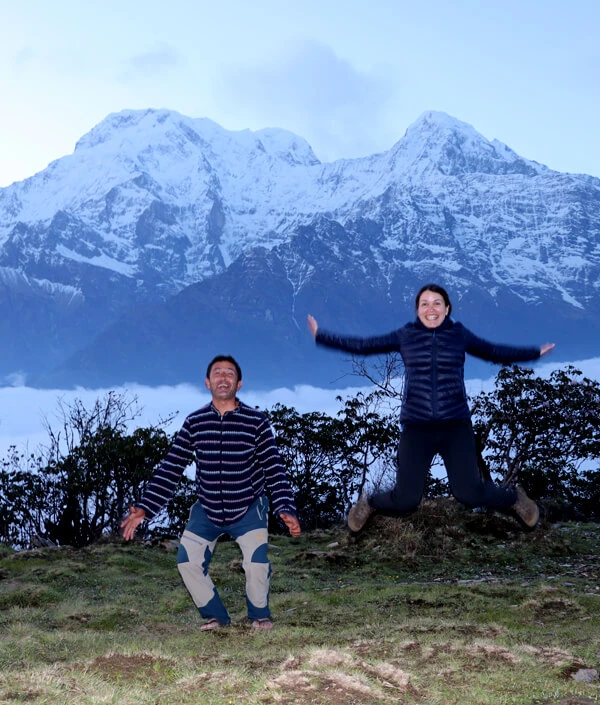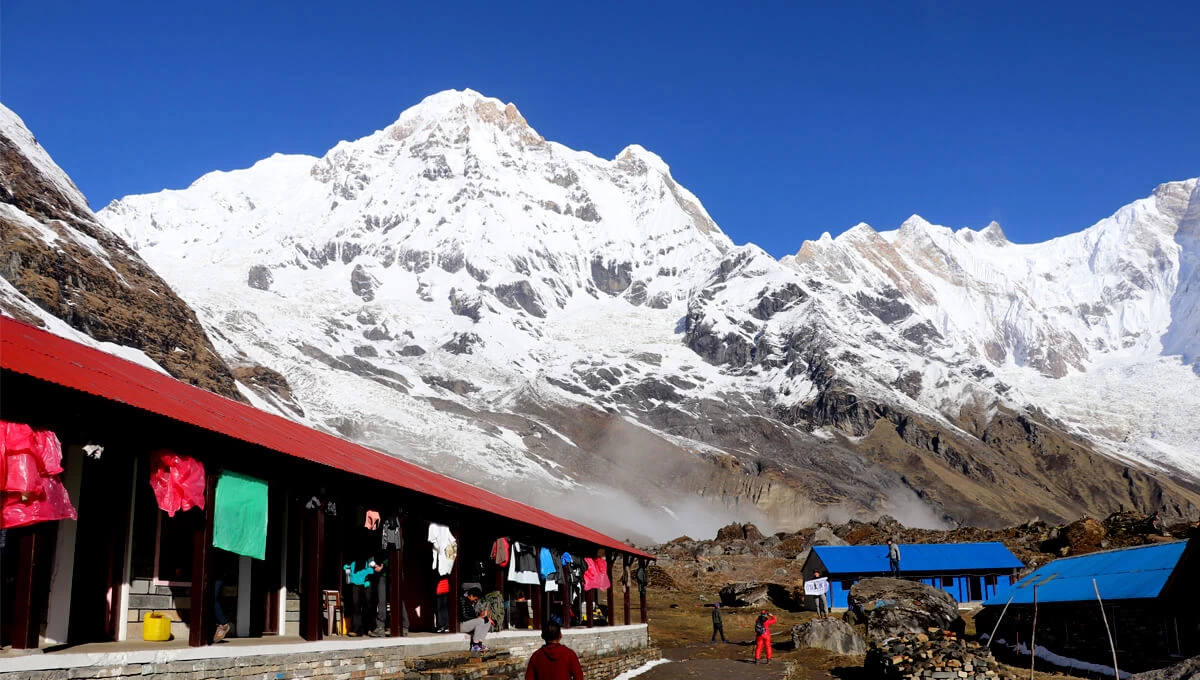
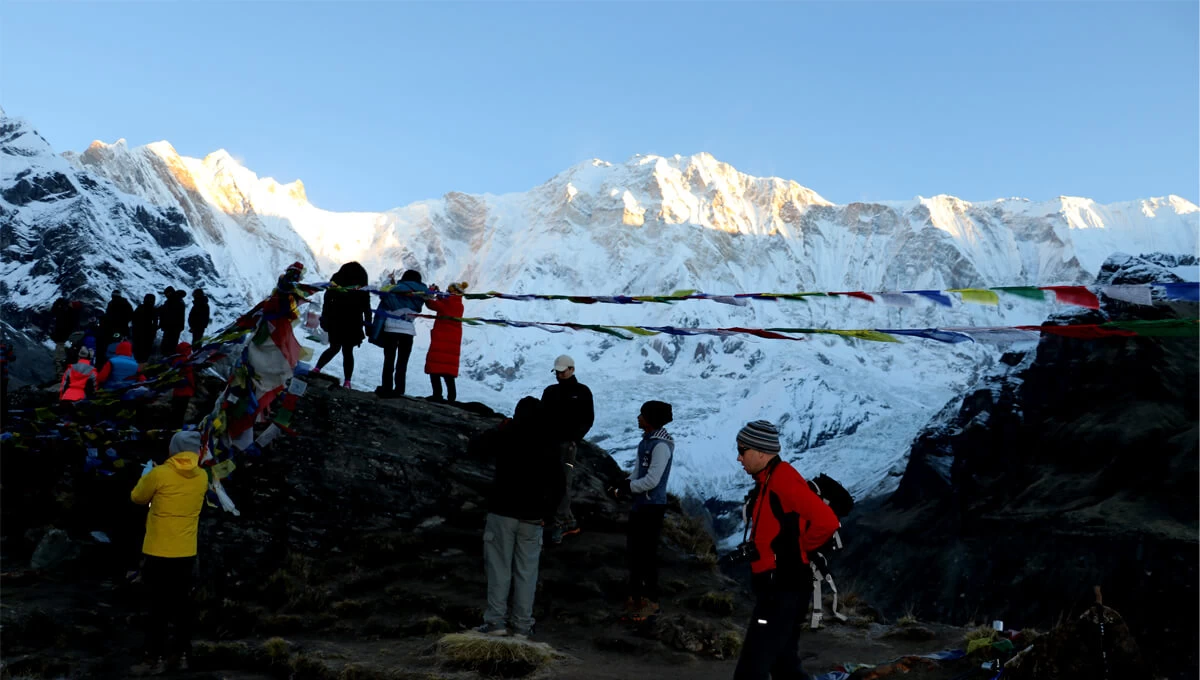
Tea house at Annapurna Base Camp with snow-covered Annapurna mountains
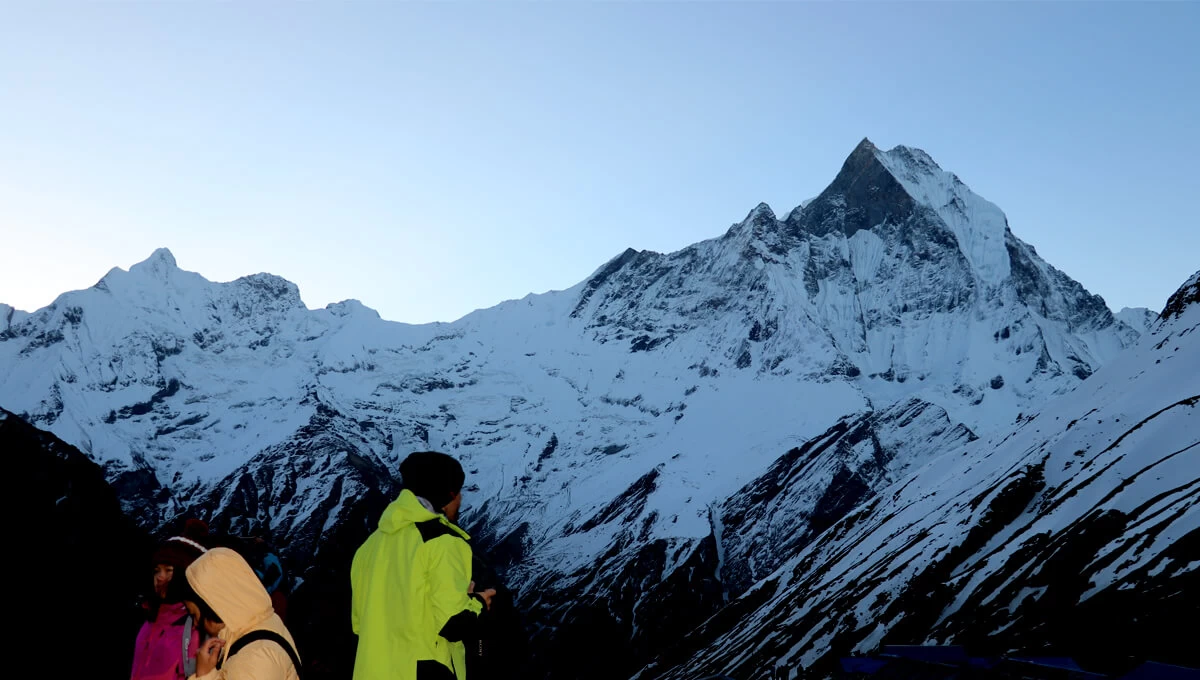
Trekkers enjoying sunrise views of Machapuchare on the Annapurna Base Camp Trek
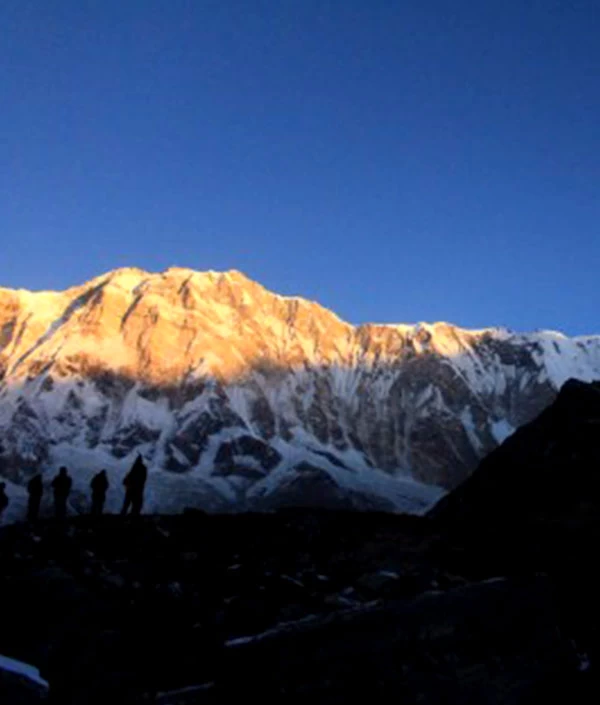
Sunrise at Annapurna Base Camp

Annapurna Base Camp Trek - 13 days

31 reviews in Trip Advisor
11 reviews in Google Reviews
Recommended by 99% of travelers
Duration
13 Days
Trip Grade
Moderate
Country
Nepal
Maximum Altitude
4,130 m (13,549 ft)
Group Size
1 - 15 pax.
Starts
Kathmandu
Ends
Kathmandu
Activities
Trekking & Hiking
Best Time
Spring and Autumn

Important Highlights of the Annapurna Base Camp Trek Nepal 

  • Wake up at Annapurna Base Camp (4,130 m) with Annapurna I, Annapurna South, Hiunchuli, and Machhapuchare rising around you. 
  • Get the first sunrise view from Poon Hill (3,210 m), as the first ray of light strikes Annapurna, Dhaulagiri, and Machhapuchare.
  • Pass through rhododendron and bamboo forests, waterfalls, and suspension bridges, with varied landscapes each day. 
  • Climb the famous stone staircases of Ulleri and Chhomrong, then pass through Machhapuchare Base Camp (3,700 m) on the final approach. 
  • Spend your evenings in family-run teahouses and talk with the people who run them. 
  • Experience the warm hosaptility of Gurung and Magar villages and see daily mountain life up close. 
  • Follow one of Nepal’s most rewarding routes through the Annapurna Conservation Area, returning by a different trail. 
  • Ease your tired legs in the natural hot springs at Jhinu Danda after days of trekking. 

Annapurna Base Camp Trek Overview 

Guiding the Annapurna Base Camp Trek 13-day route every season, we know the exact moment it starts to feel real. Our 2027 ABC Trek Nepal package begins with a drive from Kathmandu to Pokhara, then on to Nayapul, where the trail enters the Annapurna Conservation Area. 

We climb stone steps through Gurung villages to Ghorepani, then rise before dawn for Poon Hill, where Dhaulagiri and Annapurna mountains turn gold. Nights are spent in simple teahouses with warm dining rooms. 

Next, we follow the Modi Khola into the Annapurna Sanctuary, passing Machhapuchare Base Camp. The air thins and the valley walls close in, but our itinerary keeps the pace gentle and everyone comfortable. 

At Annapurna Base Camp (4,130 m), beneath Annapurna I, trekkers fall quiet, then smile. Machhapuchare, Hiunchuli, and Annapurna South flow around us while we share a quiet cup of tea. 

The Annapurna Base Camp Trek cost covers permits, guide, porters, meals, and transport, so the price stays clear. Hot springs at Jhinu Danda end the journey perfectly. 

Outline Itinerary for Annapurna Base Camp Trek 13 Days 

Day 01: Arrive in Kathmandu (1,400 m/ 4,593 ft) and transfer to your hotel in Kathmandu city. Overnight at the hotel. 

Day 02: Morning Drive from Kathmandu to Pokhara (822 m/ 2,697 ft), 7-8 hours.

Day 03: Drive from Pokhara to Nayapul and trek to Ulleri (2,040 m/ 6,693 ft), 6-7 hours. 

Day 04: Trek from Ulleri to Ghorepani (2,875 m/ 9,432 ft), approx.5-6 hours. 

Day 05: Early morning hike to Poon Hill (3,210 m/ 10,531 ft) for sunrise views, then trek to Tadapani (2,580 m/ 8,463 ft), 6-7 hours. 

Day 06: Trek from Tadapani to Sinuwa (2,340 m/ 7,677 ft), 6-7 hours. 

Day 07: Trek from Sinuwa to Deurali (3,230 m/ 10,597 ft), 6-7 hours. 

Day 08: Trek from Deurali to Machhapuchare Base Camp (3,700 m) and then to Annapurna Base Camp (4,130 m/ 13,550 ft), 5-6 hours. 

Day 09: Trek from Annapurna Base Camp to Bamboo (2,350 m/ 7,710 m), 6-7 hours. 

Day 10: Trek from Bamboo to Jhinu Danda (1,650 m/ 5,413 ft), 5-6 hours. 

Day 11: Trek from Jhinu Danda to Nayapul and drive back to Pokhara (822 m/ 2,697 ft), 5-6 hours. 

Day 12: Drive from Pokhara to Kathmandu (1,400 m/ 4,593 ft), 7-8 hours. 

Day 13: Transfer to the airport for your final departure. 

What Makes the Annapurna Base Camp Trek so Special?

Some treks impress us with the views, while others stay with us because of how they make us feel. But the Annapurna Base Camp does both, as it is not just about walking through the Himalayas. Each day here feels different. After some days, the journey leaves the terraced fields, Gurung villages, and quiet forests, and we finally find ourselves surrounded by the towering peaks of the Annapurna Sanctuary.

As the days pass by, we finally make it to the stunning Annapurna Base Camp, the final destination of your journey. Standing here gives an experience and idea of why many trekkers consider this a place blessed by the beauty of the Himalayas.

The snow-covered giants rise in every direction, while birds, mountain wildlife, and peaceful forests remind us how this region still feels. Along the way, simple conversations in the teahouses and the genuine hospitality of local families make the journey feel just as meaningful as the mountain itself.   

How Difficult is the Annapurna Base Camp Trek in 2027?

One question we hear all the time is, “Is the Annapurna Base Camp Trek really difficult?” After walking this trail many times, we can say it is more tiring than technical. Most days are spent walking for about 5 to 7 hours, but the moment we step into the teahouses in the evening, it feels more comfortable and relaxing. 

Physically, the real challenge is the long stone staircases around Ulleri and Chhomrong. They seem endless at first, but a steady pace with short breaks makes them manageable. You walk uphill and downhill every day for nine days. 

Altitude is the second challenge. The trail reaches Annapurna Base Camp at 4,130 m, where the air is noticeably thinner. Nights at Deurali and base camp are the coldest and the most likely to bring headaches or poor sleep. 

You do not need climbing experience or special mountaineering skills; a reasonable level of fitness is enough to complete this trip. Short on time or unsure about 13 days? See our Short Annapurna Base Camp or read our Annapurna Base Camp Trek itinerary guide. 

Annapurna Base Camp Trek Cost for 2027

When planning the Annapurna Base Camp Trek, it is equally important to know what exactly you are paying for to make the whole journey much easier. After organizing this trek for many years, we have found that trekkers value clear and honest pricing just as much as a well-planned itinerary.

That’s why we keep our package straightforward, with no hidden charges and confusing add-ons after you arrive in Nepal. 

Group Price Details for Annapurna Base Camp Guided Trek 

The Annapurna Base Camp Trek cost per person for 2027 depends on your group size. The more people who join, the lower the price per person gets, with no change to the itinerary, accommodation, or services. All prices are in US dollars. 

Number of trekkers Price per person in 2027
1 person US$1,099
2-4 people US$949
5-10 people US$899
11-15 people US$849
16-20 people US$799

Group size is the only factor in the table. The price is per person, so a group of 4 pays US$949 each. Optional upgrades such as private vehicle between Kathmandu and Pokhara are available on request; ask us for a quote, or tell us what you need. 

Extra Expenses to Budget for on the trail 

Drinks and bottled water, snacks, hot showers, Wi-Fi, device charging, laundry, and souvenirs are paid for on the trail, and teahouse prices rise as you gain altitude. Carry enough Nepali rupees in cash from Kathmandu or Pokhara, as ATMs are unreliable in the mountains. 

We explain every cost before the journey begins, so that no one is surprised on the trail. If you would like to know exactly what’s included or have questions about the Annapurna Base Camp Trek cost, we are always happy to walk you through the details so you can book with complete confidence. 

Annapurna Base Camp Group Departure, Small Group, and Private Trek Options 

An Annapurna Base Camp Trek group departure is the most economical way to go, as the price per person drops with group size. Single travellers regularly join our fixed departures and usually share rooms with others of the same gender. 

If you prefer a quieter pace, our Annapurna Base Camp small group trek keeps limited trekkers and is small enough for your guide to know everyone personally. 

An Annapurna Base Camp private trek lets you choose your own dates, pace, and extra rest days, and the 2-4 person price applies to couples, friends, and families. Tell us your holiday dates, budget, and fitness level through our Customize Trip form, and we will build the itinerary. 

What Does a Typical Day on the Trek Usually Feel Like?

One of the things we enjoy most about the Annapurna Base Camp Trek is how simple life becomes once we are on the trail. The day simply starts with a warm cup of tea or coffee in the morning while the mountains start to become visible from a distance.

After we are done having breakfast, we leave the place and proceed to walk further, and along the way, the beautiful suspension bridges and small villages provide a perfect place to rest and interact with fellow trekkers. 

Around midday, we have an hour-long stop at the local teahouse for a nourishing lunch before continuing further. The afternoon walk often feels quieter, with only a few people on the trail and a chance to simply catch on the stunning beauty. Some days you are surrounded by rhododendron forests, while on the other hand, the snow-capped peaks seem closer with every step. 

By afternoon, we reach our teahouse for the night. After settling into our rooms, you usually get time to relax, chat with fellow trekkers, and simply sit outside and enjoy the mountain views.

Dinner is served early here, and before you start your long conversation with your fellow trekkers and locals of the area. 

How we Reach the Starting Point of the Annapurna Base Camp Trek

Every great trek begins long before we set foot on the trail, and the Annapurna Base Camp Trek is no different. The journey starts in Kathmandu with a scenic drive to Pokhara, where the busy city starts to give way to the winding roads, green hills, and distant Himalayan peaks. Many of the trekkers fully enjoy this part of the trip because of a great chance to relax before the walking begins. 

From Pokhara, we continue by road to Nayapul, also the starting point of this trek. As per the itinerary and road conditions, we can also drive a little farther by jeep to shorten your first day’s walk. It is all because of proper road access in the Annapurna region, so our guides always choose the option to give a balance of comfort as well as a great trekking experience. 

Once we arrive at the trailhead, everything begins to slow down. The roads start to disappear, the mountain paths take over, and the peace of daily life changes completely. From that point, we walk through the mountain trails that seem closer with every step. 

Why Choose High Camp Adventure for the Annapurna Base Camp Trek?

A great trek is not just about reaching the destination, but mainly about feeling supported from the day we start planning until the day we return home. Over the years, we have learned that small details, honest communication, and a reliable local team can make a big difference on the trail. 

  • Our guides and porters are the local professionals who gain years of knowledge about the Annapurna region. They share their knowledge on the trail offers insights about the culture and mountain life as well. 
  • Safety comes first, so every itinerary is planned with a steady pace to ensure that the group can walk comfortably. 
  • Before you book, we clearly explain what’s included and what’s not, so you can plan your trip with full confidence. 
  • High Camp Adventure is a government-registered trekking company affiliated with the Nepal Tourism Board (NTB), Nepal Mountaineering Association (NMA), and Trekking Agencies Association of Nepal (TAAN). 
  • Whether you want a group departure, a small group, or a private trek, we can adapt the itinerary to your needs. 
  • At High Camp Adventure, we don’t believe in unexpected charges. Still, any personal expenses that are not included in the package are explained in advance. 
  • With years of hands-on experience in organizing treks across Nepal, we understand what really can be important to have a smooth, enjoyable, and relaxed trip from the very start of your journey. 
  • From the moment you arrive in Kathmandu, every detail of the coming journey is carefully handled by us. 
  • Ahead of your trek, we ensure that the permits are obtained, transportation is on time, accommodation is booked in advance to prevent any hassle, and daily arrangements are planned. 
Annapurna Base Camp Trek - 13 days Itinerary

Start Point: Kathmandu
End Point: Kathmandu
Expand All

Your journey begins at Tribhuvan International Airport, where our representative will be waiting to welcome you. After a warm greeting, you are transferred to your hotel in Kathmandu to rest and, if you like, stroll the nearby streets of Thamel. In the evening, we meet for a short trek briefing, check your gear, and answer your questions. 

Max Altitude: 1,400 m (4,593 ft)Meals: breakfastAccommodation: Hotel

After an early breakfast, we leave Kathmandu and follow the highway along the Trishuli and Marsyangdi rivers, passing terraced hills and small villages that show everyday life in rural Nepal. The drive is long, but as we near Pokhara, the landscape opens up and, on clear days, the first views of the Annapurna range appear. The evening is free to relax by Phewa Lake.

Max Altitude: 822 M (2,697 ft)Meals: breakfast, lunch, dinner providedAccommodation: Hotel

On this day, we drive from Pokhara to Nayapul, passing small villages and terraced fields. From the trailhead, the walk begins along a well-marked path, and the first real climb takes you up the long stone steps to Ulleri. It is a steep introduction to the trek, but the reward is a quiet hillside village and the first sense of the mountain trailhead.

Max Altitude: Nayapul (1,065 M) and Ulleri (2,040 M)Meals: breakfast, lunch, dinner providedAccommodation: Tea house

Today the trail winds through oak and rhododendron forest. During spring, the hillsides are in bloom. The air turns cooler as you climb, and the forest is alive with bird sounds. By afternoon, you reach Ghorepani, a lively trekker’s village at a crossroads of trails, with the Dhaulagiri and Annapurna ranges rising above the rooftops. 

Max Altitude: 2,875 M (9,432 ft)Meals: breakfast, lunch, dinner providedAccommodation: Tea house

We walk up early and take a steep climb to Poon Hill, one of the most famous sunrise viewpoints in Nepal. As the first light touches the Annapurna and Dhaulagiri ranges, the whole skyline turns gold. We return to Ghorepani for breakfast, then follow forested ridges to Tadapani, where Machhapuchare, Annapurna South, and Hiunchuli rise above the trees. 

Max Altitude: 3,210 M (Poon Hill) and 2,580 M (Tadapani)Meals: breakfast, lunch, dinner providedAccommodation: Tea house

After breakfast, we descend through quiet forest to the Kimrong Khola, then climb to Chhomrong, one of the most welcoming villages on the route and the gateway to the Annapurna Sanctuary. After a break here, we take the long stone staircase down and up again, crossing bamboo and rhododendron forest until we reach Sinuwa.

Max Altitude: 2,340 M (7,677 ft)Meals: breakfast, lunch, dinner providedAccommodation: Tea house

Today you walk deeper into the sanctuary. The trail passes through dense bamboo forest and follows the Modi Khola as the valley narrows between steep walls. Villages become fewer, the vegetation thins, and the air gets colder. By the time you reach Deurali, high cliffs and towering peaks surround you.

Max Altitude: 3,230 M (10,597 ft)Meals: breakfast, lunch, dinner providedAccommodation: Tea house

This is the most important day of the trek. We leave Deurali early and climb above the tree line to Machhapuchare Base Camp, where the mountains feel closer than ever. From here, it is roughly two more hours to Annapurna Base Camp. 

The final ascent is steady and well managed, and the moment you stand beneath Annapurna I, with Machhapuchare, Hiunchuli, and Annapurna South around you, every step feels worth it. We spend the evening taking in the mountain views before resting for the night at the base camp. 

Max Altitude: 4,130 M (13,550 ft)Meals: breakfast, lunch, dinner providedAccommodation: Tea house

Wake up early for the sunrise over the sanctuary before descending past Machhapuchare Base Camp and Deurali. You lose about 1,780 m of altitude today, and with every hour the air turns warmer and the landscape greener as the forest returns.

Max Altitude: 2,350 M (7,710 ft)Meals: breakfast, lunch, dinner providedAccommodation: Tea house

Today’s walk is more relaxed as you pass through forest and mountain villages and reach Jhinu Danda, known for its natural hot springs, a short walk below the village. If time allows, many trekkers soak in the warm water beside the river, the best possible way to relax your tired legs. 

Max Altitude: 1,650 M (5,413 ft)Meals: breakfast, lunch, dinner providedAccommodation: Tea house

On your last day of trekking, you descend through small villages, terraced fields, and riverside paths to Nayapul, where the vehicle waits for the scenic drive back to Pokhara. In the evening, relax by Phewa Lake and look back on your days in the mountains. 

Max Altitude: 1,650 M (Jhinu Danda) and 1,065 M (Nayapul)Meals: breakfast & lunchAccommodation: Hotel

After a relaxed morning in Pokhara, you take a drive back to Kathmandu. The journey follows rivers, rolling hills, and small villages that offer one last chance to enjoy Nepal’s countryside. This is even a great time to look back on the days spent in the Annapurna region. Once you arrive in Kathmandu, the rest of the day is free to relax, explore the city, and buy a few souvenirs.

Max Altitude: 1,400 M (4,593 ft)Meals: breakfastAccommodation: Hotel

Depending on your flight schedule, our representative will transfer you to Tribhuvan International Airport. Please arrive three hours before departure, as the airport is busy at peak times. As you board your flight, the mountain views, welcoming villages, and shared moments from the trek will stay with you long after. 

Let us help You Plan Your Perfect Holiday
Looking for a customized trip? Let us know your estimated holiday time, budget, travel style, etc. We will design an amazing personalized itinerary for you.

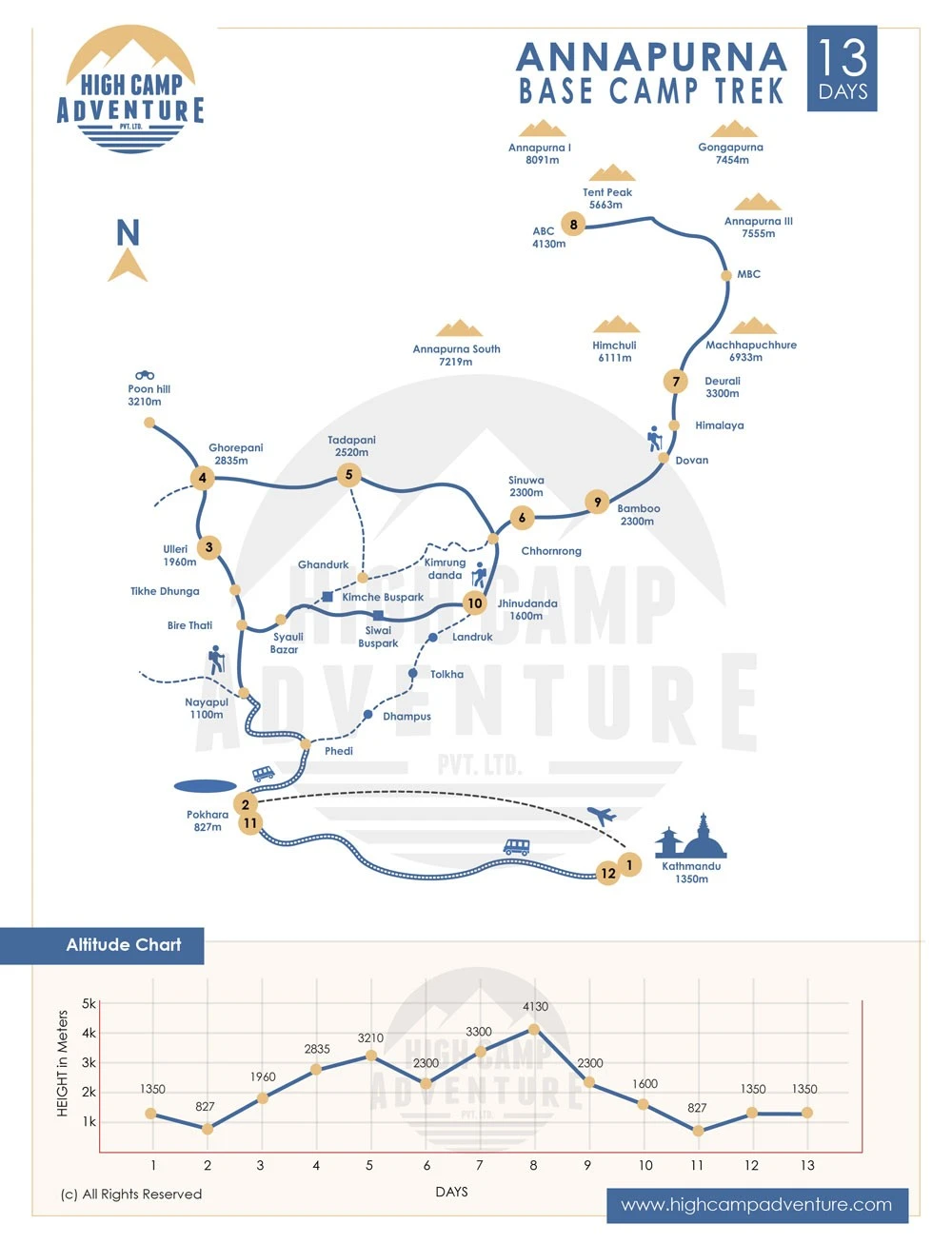
Route Map

Annapurna Base Camp Trek Map

Cost Details

Includes

  • Airport pickup and final departure transfer by private vehicle in Kathmandu. 
  • Two nights' accommodation in Kathmandu at a tourist-standard hotel with breakfast included. 
  • Two nights' accommodation in Pokhara with breakfast. 
  • Tourist bus transportation between Kathmandu and Pokhara (private vehicle available on request). 
  • Transportation from Pokhara - Nayapul - Pokhara on a comfortable vehicle. 
  • Twin-sharing teahouse accommodation throughout the trek. 
  • Three meals a day during the trek (breakfast, lunch, and dinner). 
  • Fresh seasonal fruits after dinner during the trek.
  • An experienced, government-licensed English-speaking trekking guide and local porter (one porter shared between two trekkers). 
  • Annapurna Conservation Area Permit (ACAP). 
  • Trekkers Information Management System Card if required. 
  • Guide and porter salary, insurance, meals, accommodation, and transportation are taken care of by the company. 
  • First Aid Kit carried by the guide. 
  • Company duffel bag. 
  • Government taxes and company service charges. 

Excludes

  • International airfare to and from Nepal
  • Nepal Entry Visa Fees
  • Personal trekking equipment and clothing 
  • Lunch and dinner in Kathmandu and Pokhara (except breakfast). 
  • Soft drinks, bottled water, alcoholic beverages, tea, coffee, and snacks outside the included meals. 
  • Personal expenses such as shopping, souvenirs, or additional activities. 
  • Tips for guide, porters, and drivers (tip for their service). 
  • Additional accommodation, transportation, or meals caused by personal reasons, flight delays, road closures, weather conditions, or any unforeseen circumstances beyond our control. 
  • Travel insurance that covers high-altitude trekking and emergency helicopter evacuation. 
  • Any services not specifically mentioned in the What’s included section.

Dates & Availability

Select your preferred date
Dec 2026
Departure Date
Status
Price
Departure Date
Starts: December 04, 2026Ends: December 16, 2026
Status
Guaranteed
Price
US$949
Departure Date
Starts: December 10, 2026Ends: December 22, 2026
Status
Guaranteed
Price
US$949
Departure Date
Starts: December 14, 2026Ends: December 26, 2026
Status
Guaranteed
Price
US$949
Departure Date
Starts: December 19, 2026Ends: December 31, 2026
Status
Guaranteed
Price
US$949
Departure Date
Starts: December 23, 2026Ends: January 04, 2027
Status
Guaranteed
Price
US$949
Departure Date
Starts: December 27, 2026Ends: January 08, 2027
Status
Guaranteed
Price
US$949
Departure Date
Starts: December 31, 2026Ends: January 12, 2027
Status
Guaranteed
Price
US$949

These are upcoming fixed departure dates. If you are looking for a different date, please feel free to contact us.

Essential Information

Transportation for Annapurna Base Camp Journey 

Before you arrive at the bustling city of Kathmandu, all the transportation is arranged before the trek starts. The package covers airport pick-up on arrival, a transfer to your hotel, tourist bus transportation between Kathmandu and Pokhara, and then from Pokhara to Nayapul, the starting point of the trek. After completing the trek, we also arrange your return drive from Nayapul to Pokhara, followed by transportation back to Kathmandu. 

Accommodation and Meals Option 

In Kathmandu and Pokhara, you stay in comfortable tourist-standard hotels. On the trail, you spend each night in locally run teahouses. Rooms are simple but clean, with twin-sharing beds and shared bathrooms, with facilities getting more basic as you climb. Nights are cold at the higher stops, so a warm sleeping bag helps. 

Meals are freshly cooked at the teahouses and are filling and nourishing. Expect Dal Bhat, noodles, pasta, rice, soups, eggs, and some simple Western dishes. Menus are shorter at higher altitudes, but you will always find something hearty to eat, and dinner is when trekkers share stories before another day in the mountains.

Experienced Guide and Porter Support 

Having the right team with you can make a big difference on the trail. That’s why every Annapurna Base Camp Trek is done under a licensed English-speaking trekking guide who is aware of the route, local culture, and mountain conditions. Even they let you keep the journey well-organized, answer questions, and make sure everyone feels comfortable and supported from the start. 

Our Annapurna Base Camp Trek Package also includes porter services. They let you walk more comfortably with just a light daypack that has all your personal items in it. To make the journey even more smooth and affordable for you, we take care of our team by covering the guide’s and porter’s salary, meals, accommodation, transportation, and insurance throughout the trek. 

Necessary Permits for ABC trek 

We arrange all the permits in advance, so you do not need to worry about them when you arrive in Nepal. The first is the Annapurna Conservation Area Permit (ACAP), which is required to enter the protected area. 

The fee is roughly around NPR 3,000 of foreign nationals, and is already included in your package. Depending on current regulations, a TIMS card may also be required, and we handle that too. 

Essential Trekking Gear for Annapurna Base Camp Trek

Trekking to Annapurna Base Camp requires proper planning and safety gear that must be checked well before leaving Kathmandu. This also ensures everything is safe and secure without any last-minute delays. As most of the items can be purchased or rented in Kathmandu before the trek begins, there is no need to buy everything in advance if you don’t have it. 

Clothing 

  • Moisture-wicking T-shirts 
  • Thermal base layers and thermal leggings 
  • Fleece jacket 
  • Down jacket for cold nights and mornings 
  • Waterproof and windproof jacket 
  • Comfortable trekking trousers 
  • Warm hat or beanie, and a sun hat or cap 
  • Gloves 
  • Hiking socks and comfortable underwear 

Footwear 

  • Well-broken-in hiking boots 
  • Lightweight shoes or sandals for walking around the teahouse 
  • Gaiters, only for muddy and snowy conditions 

Sleeping Gear 

  • Four-season sleeping bag that keeps you comfortable even at the teahouses 
  • Sleeping bag liner 

Personal Essentials 

  • Adjustable trekking poles 
  • Reusable water bottle or hydration bladder 
  • Water purification tablets or filter 
  • Sunglasses with UV protection, SPF 30+ sunscreen and SPF lip balm 
  • Headlamp with spare batteries 
  • Personal toiletries, quick-dry towel, wet wipes, and hand sanitizer 
  • Personal medications and a basic first aid kit 
  • Power bank and charging cables 
  • Documents and Money 
  • Passport and a photocopy; two or three passport-size photos 
  • Copy of your travel insurance policy 
  • Nepali rupees in cash for the trail; bring enough from Kathmandu or Pokhara, as ATMs are unreliable in the mountains.  

Best Time for the Annapurna Base Camp Trek

One of the things trekkers love about the Annapurna Base Camp Trek is that it can be enjoyed in every season, with each time offering a unique experience. Some trekkers come here for clear mountain views, while others prefer quieter trails. After gaining experience guiding this route through every season, we found that spring (March to May) and autumn (September to November) are the best. 

Spring (March to May)

Spring is one of the favourite times to trek to Annapurna Base Camp. The rhododendron forests are in full bloom, the days are pleasantly warm, and the mountain views are usually clear. The daytime temperatures at lower altitudes range from 15°C to 22°C, while nights at Annapurna Base Camp can drop to around -5°C to 0°C. 

Autumn (September to November)

Autumn is the busiest trekking season, as it lets you explore the beauty of Annapurna in better conditions. Your trek at this season gives you crystal-clear skies that make it easier to see some of the best views of Annapurna, Machhapuchare, and other surrounding peaks. During the day, the temperatures generally range between 12°C and 20°C, while nights at base camp can be around -5°C to -2°C. 

Annapurna Base Camp Trek in October 

October is the heart of the autumn season: the monsoon haze has gone, skies are at their clearest, and the weather is stable. It is also the busiest month, and Nepal’s big autumn festival can make transportation and hotels busier, so book your 2027 dates early. 

Annapurna Base Camp Trek in April 

April is the best month for the rhododendron forests between Ulleri, Ghorepani, and Tadapani, which burst into red and pink bloom. Days are warm, and mornings give the clearest mountain views, as haze can build at lower altitudes later in the day. 

Monsoon (June to August)

The monsoon season turns the Annapurna region into a more vibrant place, full of green forests, flowing waterfalls, and fresh mountain air. However, it makes the trails muddy, and clouds often hide the mountain views. The daytime temperature usually ranges from 18°C to 25°C, with crisp night than in other seasons. 

Winter (December to February)

Winter has a beauty of its own: the days are usually bright and peaceful, and the trails are quiet. Mornings and nights are much colder, especially at higher altitudes, and nights at base camp can fall to -10°C or lower. Good preparation and proper warm clothing are essential.

Is Altitude Sickness a Concern on the Annapurna Base Camp Trek?

It is important to remember that altitude sickness can affect anyone, even if you are fit and fine. On the way, you may get moderate symptoms like headache, loss of appetite, tiredness, dizziness, or difficulty sleeping. So, it is important to listen to your body's signs and let your guide know if you feel unwell. 

At High Camp Adventure, safety is always our first priority. So, the itinerary we have prepared lets you reduce the risk of altitude-related problems, and our experienced guides regularly check on everyone throughout the trek. If the situation requires it, the safest decision is always to descend to a lower altitude and arrange for further assistance. 

Facilities You Find Along the Annapurna Base Camp Trek

The Annapurna Trek is one of Nepal’s most popular trekking routes, and over the years, the facilities along the trail have been improved a lot. While this is still a mountain trek, most villages provide the essential services that are needed for each day. 

As you walk higher into the Annapurna region, the facilities get simpler. Even services like hot showers, WiFi, charging, and laundry are available in many teahouses at an additional cost. The trail has everything that is needed for a safe and enjoyable trek without feeling uncomfortable. 

Safety Tips for the Annapurna Base Camp Trek Nepal 

With good preparation and an experienced guide, the Annapurna trek in Nepal is safe and enjoyable. Mountain conditions can change quickly, so these simple habits make a big difference. 

  • Keep a steady pace as you climb. It saves energy and lets your body adjust naturally. 
  • Carry a water bottle and drink regularly, as trekking at altitude makes you thirstier than you expect. 
  • Tell your guide or team members if you feel even a slight headache, dizziness, or tiredness. 
  • Wear good trekking shoes and bring warm clothing and rain gear, as mountain weather is unpredictable. 
  • Protect yourself from the strong sun at altitude with sunscreen, sunglasses, and a hat even on cool days. 
  • Follow your guide’s instructions, as they know the trail, the weather, and the mountain conditions. 

Coverage for Travel Insurance 

Travel insurance is one of the most important things to arrange before starting the Annapurna Base Camp Trek. While the trail from the start is well-established and suitable for even younger ones, mountain weather and high altitude can be tough. Be mindful when you choose; make sure the policy covers high-altitude trekking, emergency helicopter evacuation, medical treatment, and trip cancellation. 

Annapurna Base Camp Trek - 13 days FAQs

The 13-day trek costs US$1,099 per person for a solo trekker, and the price falls with group size: US$949 for 2-4 people, US$899 for 5-10, US$849 for 11-15, and US$799 for 16-20. The package covers hotels, transport, the ACAP permit, a licensed guide, a porter, teahouse accommodation, and three meals a day on the trail.

Yes. You spend 9 days trekking, and the rest covers your arrival, two road journeys between Kathmandu and Pokhara, and your departure. This gives you a steady pace, a Poon Hill sunrise, and a night at base camp. If you have less time, see our 6-day Short Annapurna Base Camp Trek.

Yes. It is one of Nepal’s most rewarding treks, combining mountain villages, forest trails, and close views of the Himalayas in a single journey. 

The trek is moderate. It is more tiring than technical, with 5 to 7 hours of walking on most days. The toughest parts are the long stone staircases near Ulleri and Chhomrong and the final ascent to 4,130 m. No climbing experience is needed, but regular walking and leg training for 6 to 8 weeks beforehand will help. 

The highest point is Annapurna Base Camp at 4,130 m (13,550 ft). Along the way, you also reach Poon Hill at 3,210 m, Deurali at 3,230 m, and Machhapuchare Base Camp at 3,700 m. 

The best seasons are spring (March to May) and autumn (September to November). October offers the clearest skies, while April is the best month for rhododendron blooms. Winter and monsoon treks are possible, with colder weather, clouds, and rain.

Every package includes a licensed guide and porter, and we recommend trekking with a guide for safe navigation, permits, and peace of mind. Rules on independent trekking in Nepal have changed in recent years, so we confirm the current regulations with you when you book. 

You need the Annapurna Conservation Area Permit (ACAP), which is NPR 3,000 for foreign nationals. A TIMS Card may also be required depending on current rules. We arrange every permit for you; you only need to bring your passport and passport-size photos. 

The package includes airport transfers, four hotel nights with breakfast, transport between Kathmandu, Pokhara, and Nayapul, teahouse accommodation, three meals a day on the trek, the ACAP permit, a licensed guide and porter, a first-aid kit, and a duffle bag.

You should be able to walk 5 to 7 hours a day for nine days and manage long staircases. Regular hiking, stair training, and cardio for six to eight weeks beforehand are usually enough for a healthy beginner.

Yes. We regularly guide first-time trekkers. Train beforehand, walk slowly, stay hydrated, and follow your guide’s advice; a positive mindset will take you the rest of the way. 

Most teahouses offer internet and charging for an extra fee, but both become limited and less reliable at higher altitudes. This is why we recommend everyone carry a power bank. 

It depends on what you want. Annapurna offers varied scenery, village culture, and a lower maximum altitude of 4,130 m, while Everest takes you to the base of the world’s highest peak at 5,364 m. See our Everest Base Camp Trek 14 days for details.

No. We keep pricing transparent. Before you book, check what is included and excluded so you can budget for personal expenses such as snacks, drinks, hot showers, charging, laundry, and tips. 

Yes. We run group departures through the year, and single travelers often join them. Joining a group is also the best way to reduce the cost per person. 

It depends on the season. In spring and autumn, nights at base camp range from about -5°C to -2°C, while winter nights can fall to -10°C or lower.

Yes, from December to February. The trails are quiet, and the mountain views are clear, but it is much colder, so you need proper winter clothing.

It is possible, but expect frequent rain, muddy trails, and clouds that block the views. For clear Himalayan scenery, spring and autumn are the better choice.

What Our Guests Say?

You May Also Like

North ABC Trek

Annapurna North Base Camp Trek - 7 Days

Price From
US$399
Explore
Annapurna South and Hiunchuli ABC Trek

Short Annapurna Base Camp Trek - 7 Days

Price From
US$399
Explore
Annapurna Panorama Trek

Annapurna Panorama Trek - 7 days

Price From
US$399
Explore
Need Help? Call Us+977 9851031822